Your Reporting Isn’t Broken — Your System Is: Design Reporting for Speed, Trust, Action
 Rustom Sutaria
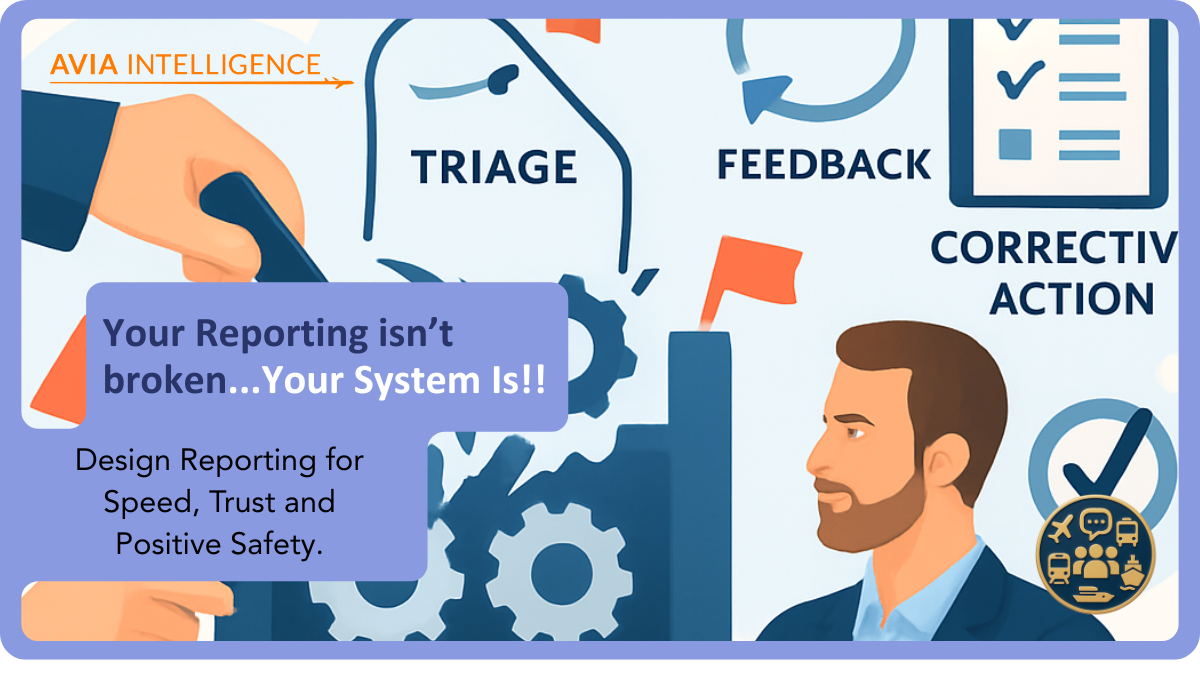
Fix safety reporting by redesigning or introducing triage, feedback loops, and corrective actions—so people trust the system and learning sticks.
If you’re a Safety Manager, you already know the pattern.
You ask for more safety reporting. You get…noise....or worse: silence.
You launch a new form. You run a new campaign. You repeat the message: “Safety Reporting is Critical.”
Yet, reports arrive late, thin, defensive or purely compliance-driven. Front-line teams don’t feel heard. Supervisors feel exposed. Investigations drag. Corrective actions drift. The feedback loop fails. And your “learning culture” becomes a slide-deck phrase rather than a lived experience.
That’s not a reporting problem, it's a system design lacking in Safety Culture.
Because reporting is not an app, a mailbox, or a policy statement. Safety Reporting is a workflow - a sequence of decisions that must be fast enough to build and retain trust, structured enough to produce continuous learning and disciplined enough to drive corrective actions that actually change work and reflect 'Work as done'.
Let’s design the workflow properly.
The reporting flow you have (whether you admit it or not)
Every safety reporting system—formal or informal—answers five questions:
- Where does information enter? (channels, accessibility, anonymity options)
- What happens first? (triage, immediate risk handling, who sees it)
- How is it interpreted? (taxonomy, severity/likelihood, context capture)
- What decisions get made? (containment, investigation, escalation, ownership)
- What comes back to the reporter? (feedback loop, transparency, learning)
If any one of these is slow, vague, or punitive, you don’t just lose “data quality.” You lose trust, and trust is the fuel of safety reporting. So stop asking, “How do we get more reports?”
Start asking, “How do we remove friction, fear, and delay from the workflow?”
Step 1: Start with speed — triage is your trust engine
People don’t decide whether reporting is “worth it” based on your policy. They decide based on what happened last time. If the first response takes days or weeks, you’ve taught the organisation that reporting disappears into a black hole.
Design triage like an operational control function:
- Set a triage SLA (e.g., acknowledgement within 24 hours; initial classification within 72).
- Separate “receipt” from “resolution”: fast acknowledgement doesn’t mean you’ve solved it; it means you respected the reporter.
- Use a simple triage model:
- Immediate containment needed? (stop/hold/brief/temporary control)
- Local fix possible? (supervisor action + record + close)
- Systemic signal? (investigate, trend, barrier impact)
- Serious risk / regulatory threshold? (formal escalation, protected handling)
This is where your risk picture begins to sharpen. Not from dashboards, but from disciplined first handling.
Step 2: Just Culture is not a poster — it’s a decision pathway
Most organisations say they want Just Culture. However, their reporting workflow quietly communicates the opposite. If reporters fear they’ll be blamed, they will:
- sanitise descriptions,
- omit context,
- avoid names,
- delay submission, or
- simply not report.
Just Culture becomes real when you build fair treatment into the workflow:
- Define what gets protected (e.g., self-reporting protections, confidentiality boundaries).
- Define what gets escalated (e.g., wilful violations, sabotage, substance misuse—per your policy and legal context).
- Train triage owners in consistent classification so that “accountability” doesn’t drift into scapegoating.
- Create a standard “context capture” prompt:
- What made sense at the time?
- What pressures were present?
- What tools/information were missing?
- What workarounds are normal here?
When people see that the system is trying to understand work-as-they-do it and not hunt for culprits—you’ll see reporting quality rise without pleading for it.
Step 3: Build a real feedback loop — not a courtesy email
A feedback loop is not “Thanks for your report.” A feedback loop is: “Here’s what changed because you spoke up.” If you want a learning culture, you must give feedback at three levels:
- Personal feedback to the reporter (fast, respectful, specific).
- Local feedback to the team (what we learned; what we’re trying next).
- Organisational feedback (trends, barrier health, recurring conditions, decisions made).
A simple design pattern that works:
- Acknowledgement: within 24 hours
- First update: within 7 days (even if the answer is “still assessing”)
- Closure note: what decision was made and why
- Learning release: a short de-identified “what changed” summary (when appropriate)
No feedback loop = no trust.
No trust = no reporting.
No reporting = a false risk picture.
Step 4: Stop drowning in reports — design your taxonomy and minimum dataset
Many reporting systems fail because they treat every report as a mini-investigation. Don’t do that.
Define a minimum dataset that makes reports usable without burdening the front line. You want enough structure for triage and trend integrity, without forcing people into admin theatre.
- Minimum dataset (example):
- what happened (plain language),
- where/when (context),
- what could have happened (potential severity),
- what helped / what failed (barriers, resources),
- immediate actions taken,
- optional attachments (photos, screenshots, records).
Then define a clean, limited taxonomy that supports:
- triage routing,
- barrier impact,
- corrective actions classification,
- trend analysis.
If your categories don’t map to decisions, they’re just spreadsheet decoration.
Step 5: Corrective actions must be engineered, not promised
Here’s the harsh truth:
Most “corrective actions” are really comfort statements.
- “Refresher training” (with no change to conditions)
- “Remind staff” (with no removal of conflicting objectives)
- “Update procedure” (that nobody can apply in real time)
A robust safety reporting workflow produces corrective actions that:
- reduce exposure,
- strengthen barriers,
- remove recurring conditions,
- and can be verified.
Try this corrective action discipline:
- Owner named (not a department)
- Due date linked to risk (not convenience)
- Action type labelled
(engineering, process, staffing, tooling, training, supervision, supplier/interface) - Effectiveness check defined (how you’ll prove it worked)
- Visibility built-in (action tracking is part of governance, not an Excel graveyard)
This is where reporting becomes governance and how you protect the risk picture from wishful thinking.
The system test: can you answer these five questions today?
If you want to know whether your safety reporting system is fit for purpose, ask yourself:
- Can every reporter predict what happens next?
- Can you triage fast enough to preserve trust?
- Is Just Culture visible in how decisions are made—not just what you say?
- Does your feedback loop prove learning, not just harvest data?
- Do corrective actions reliably change work and strengthen controls?
If any of those answers is “no,” reporting isn’t broken. Your system is.
Believe it or not, that’s good news—because your systems can be redesigned.
If you want help redesigning and re-building your safety reporting workflow - triage, Just Culture, feedback loop, and corrective actions—so your organisation builds a genuine learning and positive safety culture, not least a defensible risk picture:
Email me: contact.us@aviaintelligence.com
Or register with our community website, The Safety Rebels Club.