Your Barriers Are Aging | How Do you Prove Your Controls Still Work?
 Rustom Sutaria
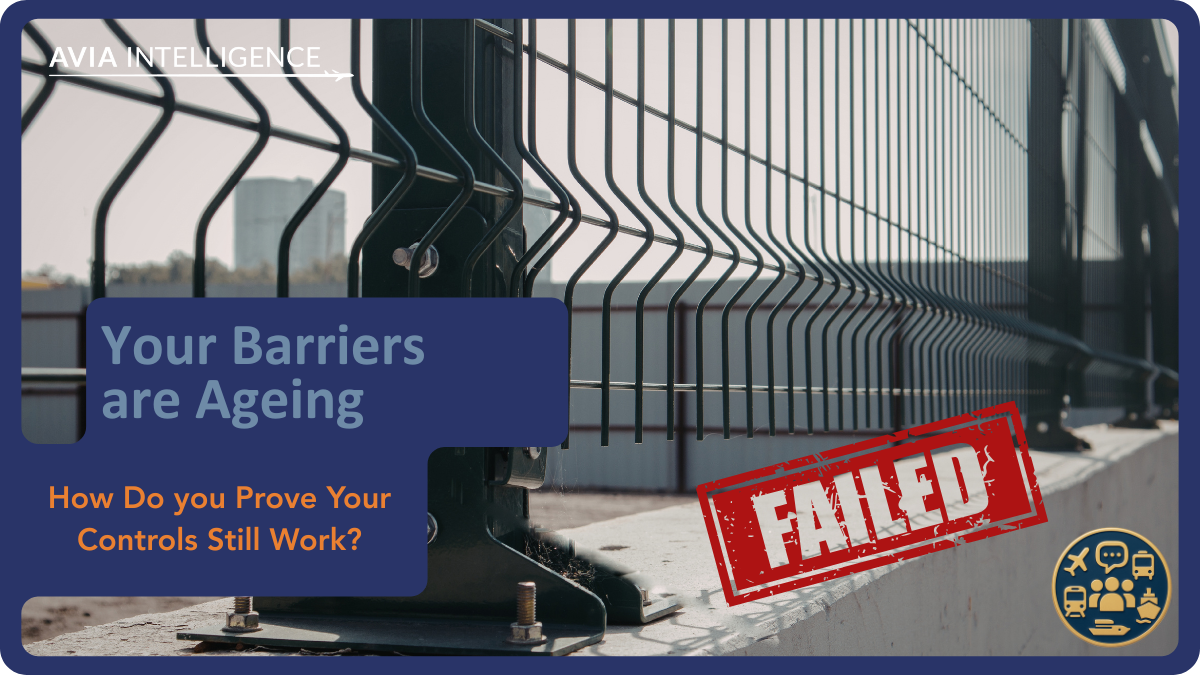
Controls can look fine on paper and still fail in practice. Here is how Safety Assurance teams can test whether barriers still work.
You may already have controls in place. Procedures exist. Checklists are signed. Audits are completed. Dashboards are green.
However, none of that proves your barriers still work when operations get busy, conditions change or people workaround around the system.
This is the problem with aging controls. They rarely fail all at once. They weaken gradually.
A briefing becomes rushed. A verification step becomes assumed. A maintenance defence is still present in the manual, but no longer applied with the same discipline.
On paper, the control survives. In practice, its effectiveness has faded or even lost.
That is why Safety Assurance cannot stop at compliance evidence alone. You need to test control effectiveness, not just control existence.
This is where risk analysis helps. It forces you to ask a sharper question: what are the barriers that prevent threats from turning into events and what assurance tells you those barriers are healthy today? Not last year. Not at the last audit. Today!!!
Good assurance looks for signs of barrier drift. It checks whether the control is understood, available, used correctly, and still suited to the way work is actually done. A control may be technically valid but operationally weak. That gap matters!
This is also where many audits fall short.
They confirm whether a requirement has been addressed, but they do not always prove whether the barrier still performs under real conditions that may have changed with time.
Your audit programme should be supported by targeted monitoring.
Watch what happens in practice.
Sample the work.
Review deviations, workarounds, delays, repeat findings, and handover quality.
Speak to the people using the control.
Ask what makes it hard to apply consistently.
A strong assurance approach blends document review, operational observation and meaningful follow-up.
It does not just ask, “Is the control there?”
It asks, “How confident are we that this barrier will hold when pressure rises?”
That shift changes the value of your safety system. Instead of collecting evidence for closure, you build evidence for confidence. Instead of assuming barriers are healthy because they were once designed well, you verify that they remain effective in live constantly evolving operations.
For Safety Assurance roles across transport, that is the real task. Your job is not simply to confirm that controls were introduced and are effective. It is to prove they still protect!
Because barriers do age. The question is whether your assurance system is strong enough to notice before the control concerned is no longer effective and the next event does.
If you want to strengthen barrier assurance and prove your controls still work in practice, email contact.us@aviaintelligence.com or join the Avia Safety Collective on Zenler.