The 10 Virtues of Positive Safety Culture
 Rustom Sutaria

A Practical Framework for Safer Organisations
The Missing Piece in Safety Management
It's 2am. You are on the night shift and you're reviewing audit reports, training records, compliance metrics and incident statistics. On paper, everything appears to be under control. Yet something still feels uncertain.
Many transport organisations face this challenge.
Despite significant investment in systems, procedures, and compliance programs, leaders often struggle to answer a simple question:
What does positive safety culture actually look like in everyday work?
Ask ten people in your organisation and you likely to receive ten different answers.
The issue is rarely commitment. The issue is often the absence of a practical framework that connects safety culture to observable behaviours and organisational conditions.
Why Safety Culture Still Struggles
For years, organisations have measured safety through:
- Compliance performance
- Audit findings
- Training completion
- Reporting volumes
These indicators provide useful information, however, they do not necessarily reveal how work is performed under real-world conditions.
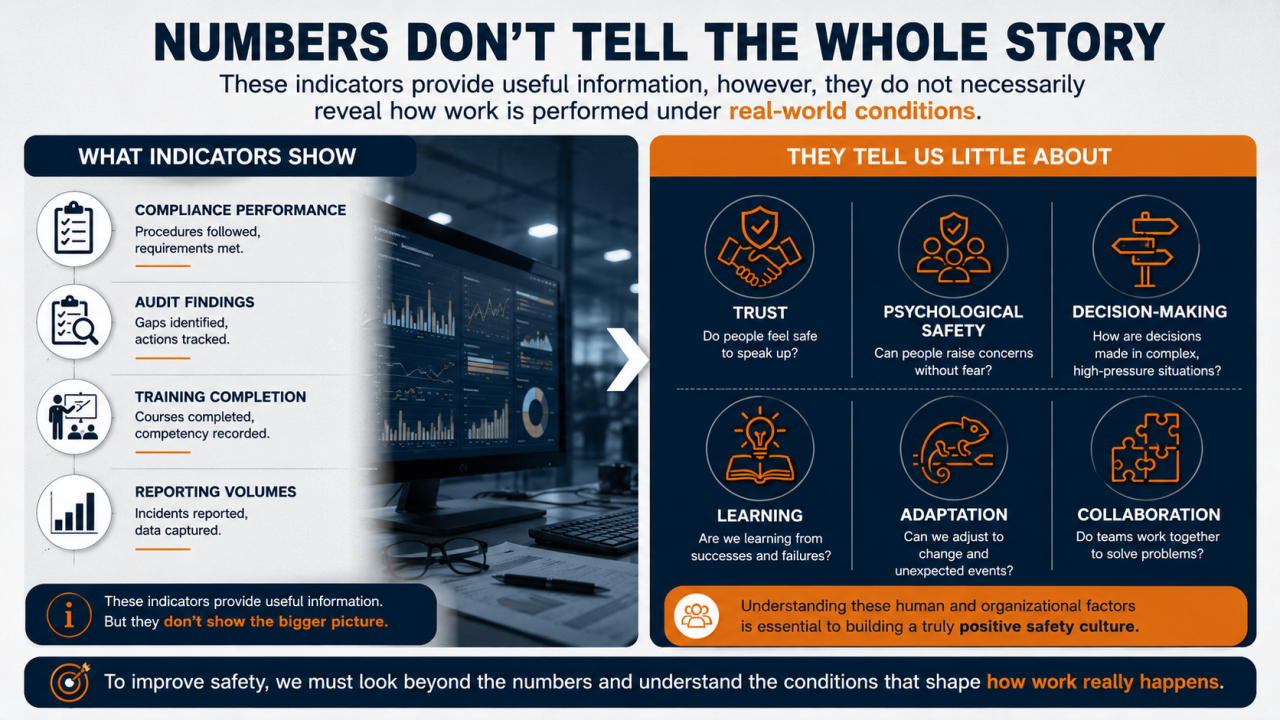
Many organisations can describe the controls they have implemented. Far fewer can describe the conditions that enable people to make safe and effective decisions when complexity and operational pressures emerge.
This is where safety culture often struggles.
The Need for Modern Safety Thinking
Modern safety thinking recognises an important reality:
People are not simply sources of error. They are also the source of flexibility, adaptation, recovery, and learning.
In transport operations, procedures cannot anticipate every situation, variation, or challenge.
Success often depends on how people respond, communicate, adapt, and make sense of changing conditions.
The question therefore becomes:
How do we create environments that help people succeed?
Positive safety culture emerges when organisations deliberately create conditions that support learning, trust, accountability, open communication, and informed decision-making.
Culture Lives in Everyday Work
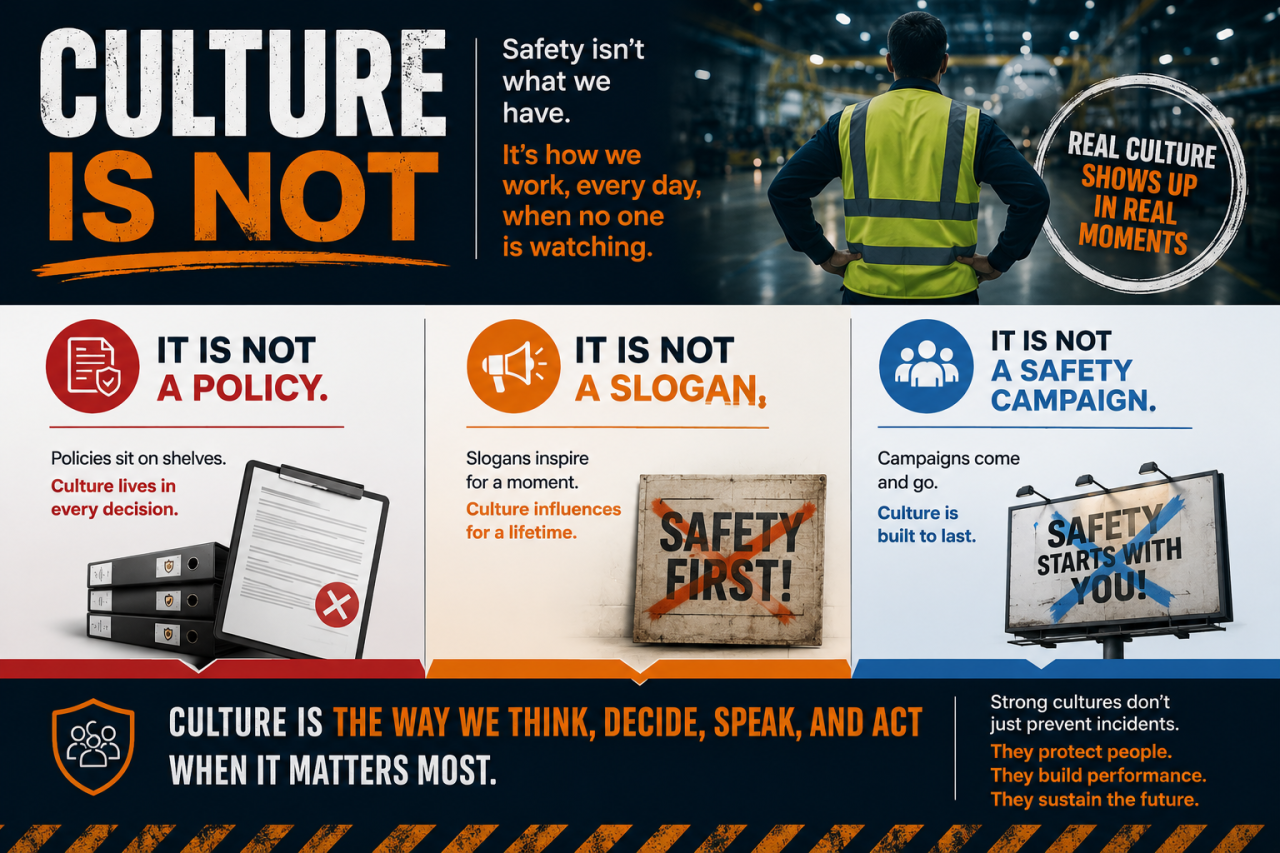
Culture emerges through everyday interactions between people, leaders, teams, systems, and operational demands.
It can be observed in:
- How concerns are raised?
- How mistakes are discussed?
- How leaders respond to bad news?
- How learning is encouraged?
- How competing priorities are managed?
Without shared behavioural expectations and supportive organisational conditions:
- Learning becomes inconsistent.
- Weak signals are overlooked.
- Employees interpret safety differently.
- Trust deteriorates.
- Compliance is mistaken for effectiveness.
From Compliance to Capacity
Traditional approaches often focus on controlling failure. Modern approaches focus on building the capacity for success.
This requires organisations to move beyond asking: "Why did people fail?"
And begin asking:
"How do people normally succeed, and how can we strengthen those conditions?"
This is where the 10 Virtues framework becomes valuable.
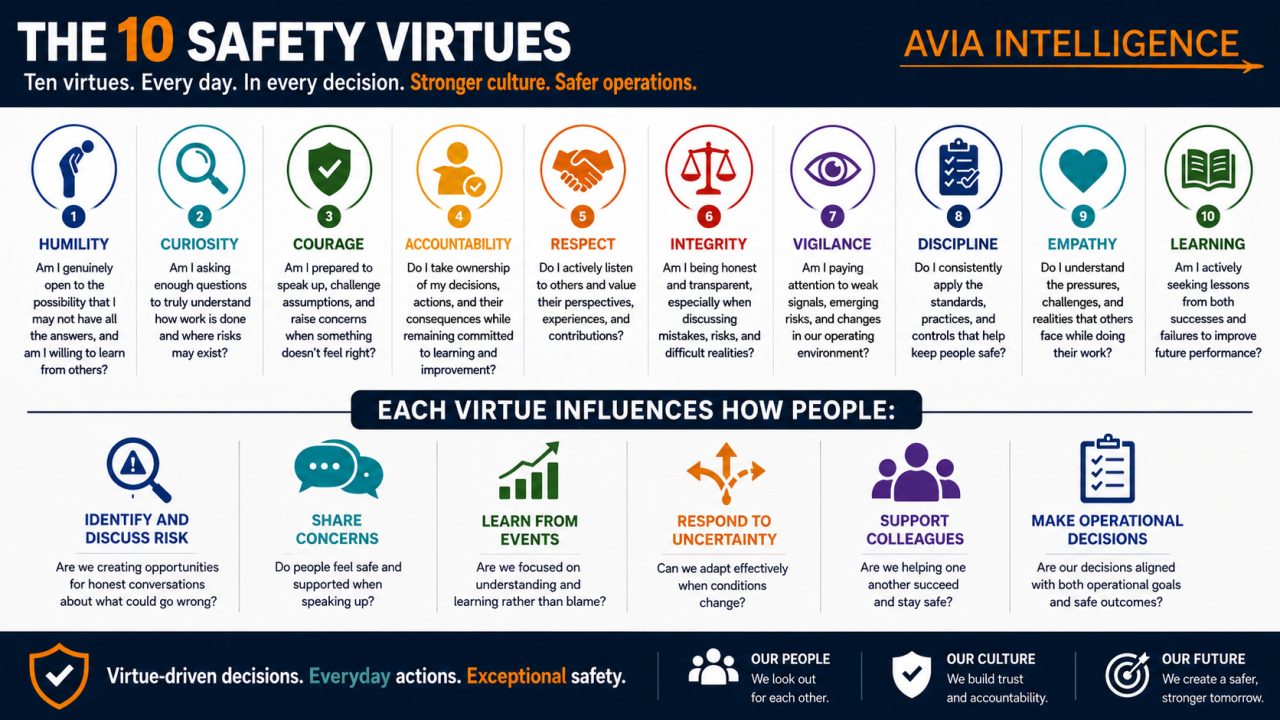
The 10 Virtues of Positive Safety Culture
The 10 Virtues are not intended as personal characteristics that individuals must possess.
Rather, they are behaviours that healthy organisations encourage, support, and reinforce.
- Humility
- Curiosity
- Courage
- Accountability
- Respect
- Integrity
- Vigilance
- Discipline
- Empathy
- Learning
Each virtue influences how people:
- Identify and discuss risk
- Share concerns
- Learn from events
- Respond to uncertainty
- Support colleagues
- Make operational decisions
Together, these virtues provide a practical framework for understanding culture beyond compliance.
They help leaders focus not only on what people do, but on the organisational conditions that shape behaviour.
Every organisation says safety is important.
However, safety culture becomes real when people experience an environment where speaking up is encouraged, learning is valued, and operational realities can be discussed openly without fear.
The most important question may not be: "Do we have the right procedures?"
It may be:
"Are we creating the conditions that allow people to make good decisions when procedures alone are not enough?"
If your procedures disappeared tomorrow, what organisational values and behaviours would remain to guide the decisions your people make?
Which of the 10 Virtues do you believe is strongest in your organisation today and what conditions have you created that allow it to flourish?
That conversation may reveal more about your safety culture than any compliance metric ever could. What are your thoughts?
Join the discussion in the comments, share your perspective here on the blog, or contact us directly at contact.us@aviaintelligence.com.
If this article has raised questions about your organisation's performance, culture, assurance processes, or safety leadership, I'd be pleased to discuss them with you.
Questions, observations, or a different perspective? I'd be pleased to hear from you.