Root Cause Is a Starting Point: Build Learning That Sustains Safety
 Rustom Sutaria
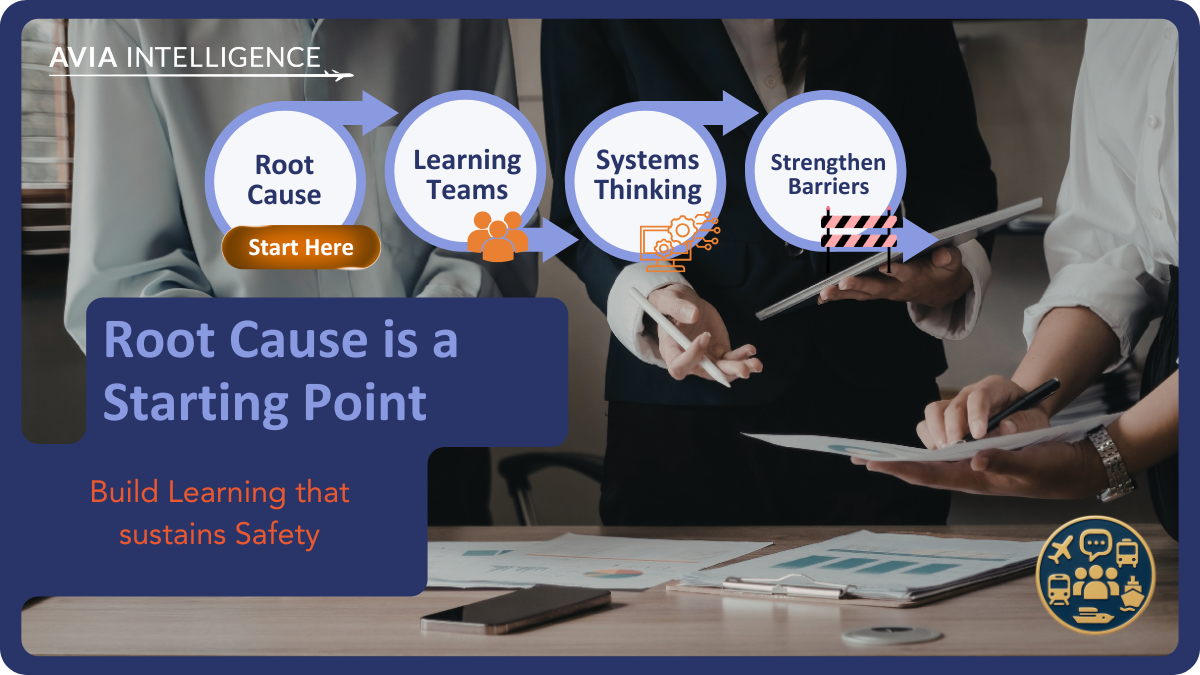
Root cause is step one. Use learning teams, systems thinking, and stronger barriers to turn investigations into effective and lasting safety change.
You already know why “root cause” matters. If you can’t identify what contributed to an event, you can’t justify change, defend decisions, or stop recurrence.
But here’s the problem: root cause has quietly become the finishing line.
Your investigation lands. You document root causes and contributing factors. You assign corrective actions. You close the report. Everyone breathes out!
Then, months later, something similar happens again—because the investigation didn’t change the way you work regarding safety. It only changed your paperwork. This makes you more compliant, but does it make you safer?
If you want safety to improve in a way that holds under pressure, treat root cause as step one, not the outcome. The real outcome is learning that strengthens barriers and supports work-as-done.
Root cause is useful - until it becomes a trap.
Most Safety Managers are chasing root cause because it’s how organisations create a narrative that feels actionable.
However, “root cause” thinking can drift into three common traps:
- Single-cause comfort:
Complex operational conditions get reduced into one neat explanation. - Person-shaped causes:
Even with good intent, the story tilts toward individual decisions over system conditions. - Action theatre:
Retraining, reminders, and procedural edits look like progress, but rarely reduce exposure.
This is where systems thinking and human factors stop being “nice to have” and become e"need to have". They help you see how outcomes potentially emerge from normal work, not from isolated failure.
Replace “What or who caused it?” with
“What were the circumstanced that allow the decisions to make sense at the time?”
If your investigation questions keep pointing at human-error, you’ll keep producing error-error based fixes.
Try shifting the centre of gravity of your investigation. Ask:
- What was the operational demand at the time?
- What constraints shaped decisions (time, tooling, staffing, information, authority)?
- What trade-offs were your people making to keep the job moving?
- What hazard related signals were visible but normalised or discounted?
- Which controls/barriers were relied on and were they already fragile?
This is not about excusing poor decisions. It’s about explaining why decisions were made in the system you as manager designed, and what that reveals about system health.
That’s what “learning” actually is: a defensible explanation that leads to meaningful change, before it turns into a safety or compliance related event.
Learning Teams:
Turn investigations into usable learning
A well-run investigation shouldn’t end with “who did what.” It should end with “what must we change so work remains safe under real conditions.”
That’s where learning teams are powerful.
A learning team involves a structured conversation with the people closest to the work. Here you are focusing on understanding work-as-done, not to interrogate compliance (too much). The learning team will give you insight into:
- How the task is really executed (not how it’s described),
- Where your system creates pressure, ambiguity, and drift,
- Where workarounds are compensating for procedural or even product design flaws,
- Where handovers and interfaces create hidden weak links.
When you combine learning teams with systemic thinking, your investigations stop producing generic actions and start producing targeted system improvements.
Corrective action that actually corrects something.
Most corrective actions fail because they target behaviour instead of the conditions conditions that prompt behaviour.
Use this simple test on every action you propose:
- If the same conditions exist tomorrow, will the same outcome still be possible?
- If you replaced the person, would the system still be vulnerable?
- If you removed the reminder email, would anything materially change?
High-quality corrective action does at least one of these:
- Strengthens barriers
(controls become more reliable, less dependent on memory or heroics). - Reduces demand
(cuts unnecessary complexity, conflicting priorities, avoidable workload). - Increases capacity
(time, tools, staffing, clarity of authority, access to expertise). - Fixes interfaces
(handovers, escalation triggers, decision rights, cross-team coordination). - Improves feedback loops
(faster learning, visible outcomes, fewer reporting “black holes”).
If your action list is dominated by retraining and procedure updates, you’re often treating symptoms and leaving latent exposures untouched.
End investigations with barrier decisions, not blame decisions
If you want sustainable safety, also connect investigations to barrier health or status.
That means your investigation conclusion should answer:
- Which barriers failed, degraded, or were missing?
- How do we know those barriers are effective today?
- What (if any) early indicators will tell us they’re weakening again?
- Who owns each barrier—and what support do they need?
This is how investigations build operational resilience: not by producing more documents, but by improving the organisation’s capacity to detect drift, absorb pressure, and recover safely.
A practical way to start next week
On your next event review—small or large, react by running this lightweight sequence:
- Hold a short learning team with the people closest to the work.
- Map work-as-done: demand, constraints, trade-offs, adaptations.
- Identify the top three barriers you relied on.
- Choose one barrier-strengthening action that removes fragility (not adds admin).
- Do a 30-day check: did work actually change, or did the paperwork just close?
Repeat this consistently and your reporting system stops being a mailbox. It becomes a learning engine.
Call to action
If you want to redesign your investigation approach so it produces real systems learning and stronger barriers—not more “root cause paperwork”—email me at contact.us@aviaintelligence.com.
Or register with our community website: The Safety Rebels Club