Human Error Is the Beginning of the Story
 Rustom Sutaria

Why transport leaders must move beyond blame to understand how positive safety culture is really created.
Human Error Is Only the Beginning of the Story
Why transport leaders must move beyond blame to understand how safety is really created.
An operational disruption occurs. A safety event, procedural deviation or unexpected outcome interrupts normal operations. Almost immediately, attention shifts toward the individual involved.
Who made the mistake?
Why wasn’t the procedure followed?
Who is accountable?
For many transport organisations, these questions appear quickly - often before the broader operational picture has been fully understood and while accountability matters deeply in transport operations, modern safety thinking increasingly recognises an important truth:
Human error should not be the end of the investigation. It should begin it.
This is because people’s decisions and actions are shaped continuously by the systems, conditions, and operational pressures surrounding them. This shift in thinking is fundamental to building stronger safety cultures.
Why has Human Error become the Conclusion?
Historically, organisations have often treated human error as the final explanation because it creates clarity. It feels actionable. It simplifies uncertainty.
If a procedure was not followed or an incorrect action or outcome occurred, the investigation can appear complete once the individual behaviour has been identified, but this creates a dangerous illusion.
Once such outcomes are known, hindsight changes how decisions are viewed.
Actions that may have appeared reasonable, necessary or adaptive in real time suddenly look irrational after the fact. This is where many investigations unintentionally stop learning too early.
Corrective actions become focused on retraining, reminders, disciplinary responses or procedural reinforcement - while the deeper operational conditions remain largely untouched.
The Result: Human error is labelled to the event, but understanding never fully develops.
Human Performance Is Shaped by Context
Transport operations are complex, high-pressure environments. It is worth remembering that, your people rarely work under ideal conditions. Their performance is influenced constantly by operational realities such as:
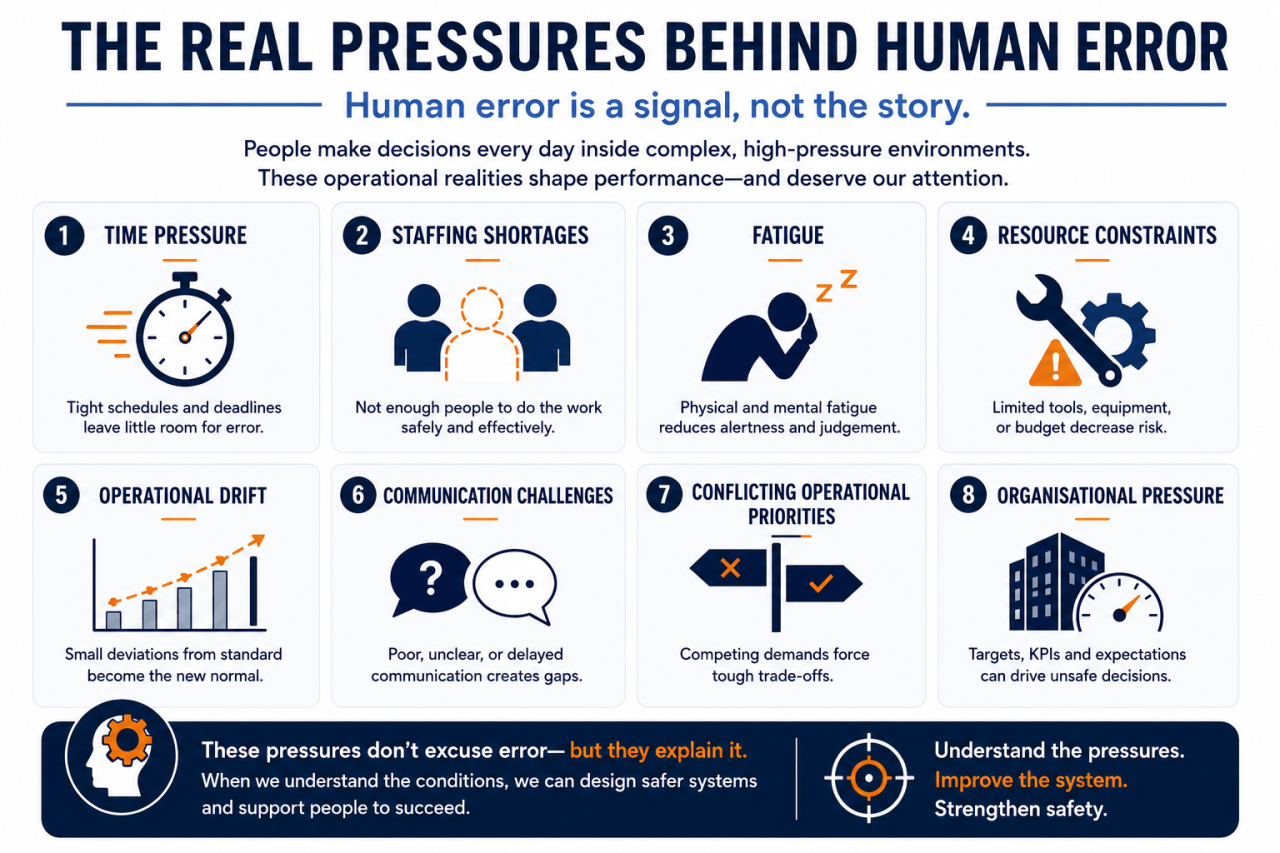
Modern safety leadership recognises that people are not simply sources of risk within systems. They are also the source of adaptability, recovery, and operational success.
This changes the purpose of investigation. Instead of asking only: “Who failed?”
Leaders may begin by asking: “Why did those actions make sense at the time?”
That question creates something far more valuable than blame: Operational understanding.
It acknowledges the important difference between work-as-imagined and work-as-done. Procedures describe how work should occur under ideal conditions. Operational reality often requires adaptation, judgement and trade-offs under pressure.
If organisations fail to understand that reality, they risk designing safety systems disconnected from actual operational work.
The Cost of Blame-Focused Cultures
When investigations focus primarily on fault, organisations often create unintended consequences.
- People become more cautious about speaking openly.
- Reporting decreases.
- Operational concerns remain hidden.
- Silence itself becomes operational data.
A reduction in reported issues does not always indicate safer operations. In some cases, it reflects decreasing trust inside the reporting environment.
Psychological safety and operational safety are closely connected. People are far more likely to report hazards, admit mistakes and share operational concerns when they believe they will be treated fairly and heard constructively.
Strong safety cultures understand this. They recognise that learning depends on openness, trust, and leadership humility.
Reframing the Role of Safety Leadership
This perspective does not remove accountability. Accountability remains essential.
However, accountability without understanding rarely improves your systems in a meaningful way.
Leaders responsible for transport safety must move beyond the idea that identifying human error completes the investigation.
Instead, human error should trigger deeper questions about system design, operational pressures, resource allocation, communication, supervision and organisational priorities.
The strongest organisations increasingly focus on:
- Understanding operational context
- Studying work-as-done
- Improving visibility into everyday pressures
- Encouraging reporting before failure escalates
- Learning from normal work, not only adverse events
- Treating human error as insight into system conditions
This approach reflects a more mature understanding of safety performance. Not one built purely on compliance and blame, but one built on learning, adaptability, and operational awareness.
Practical Leadership Reflections
Leaders should regularly ask:
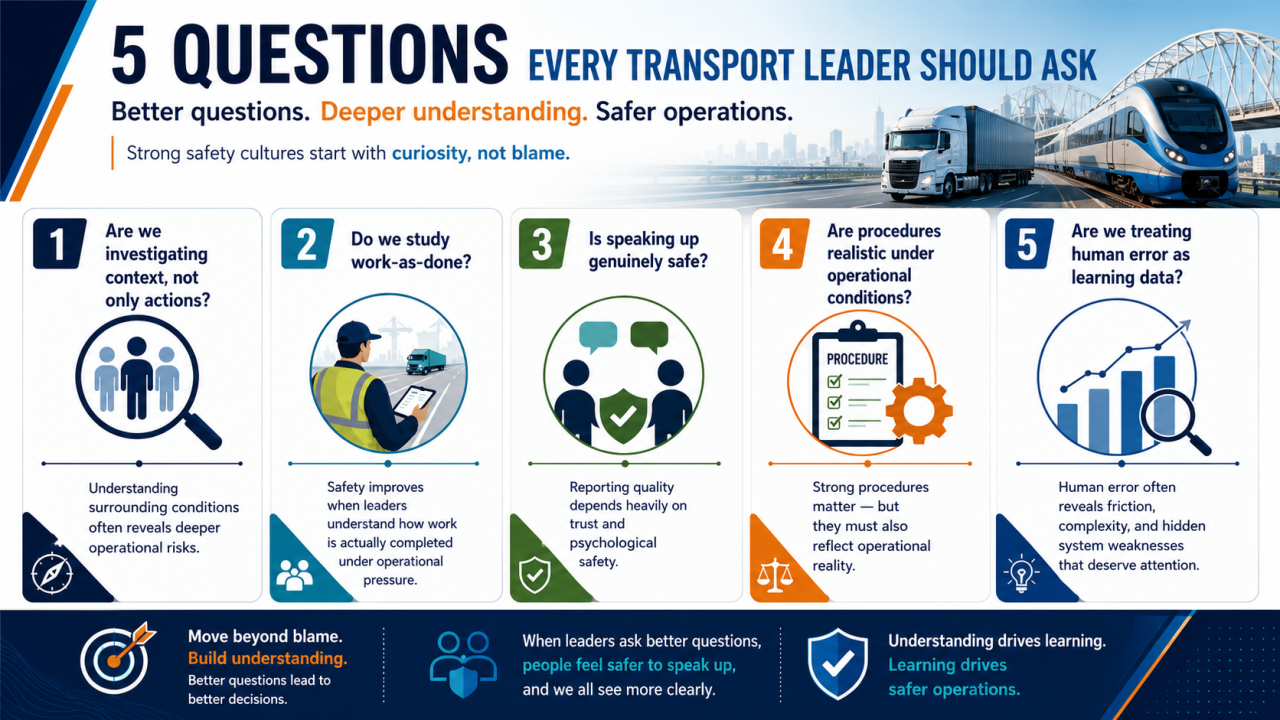
Human error is not the end of the story.
Human Error is often the beginning of understanding how systems, pressures, and operational conditions shape performance.
The organisations that improve safety most effectively are not necessarily the ones that investigate blame fastest. They are the organisations willing to learn deeply enough to improve how people succeed under pressure.
The reality is simple, safer operations are not created by pretending humans will never err.
They are created by understanding why human performance unfolds the way it does and by building systems that support people before failure occurs.
As a leader, the following is worth reflecting upon:
When human error appears inside our operations…do you stop at blame or do you begin learning?
What are your thoughts?
Every organisation is different. How do these ideas apply in your operational context?
Questions, observations, or a different perspective? I'd be pleased to hear from you.