How Past Success Quietly Rewrites Your Risk Radar
 Rustom Sutaria


A long safety record can change how your team sees risk. Why success makes hazards look smaller and what that costs.
The Safety Review Board meets at 09:00 on the first Monday of the quarter. The first slide shows one number in large green figures:
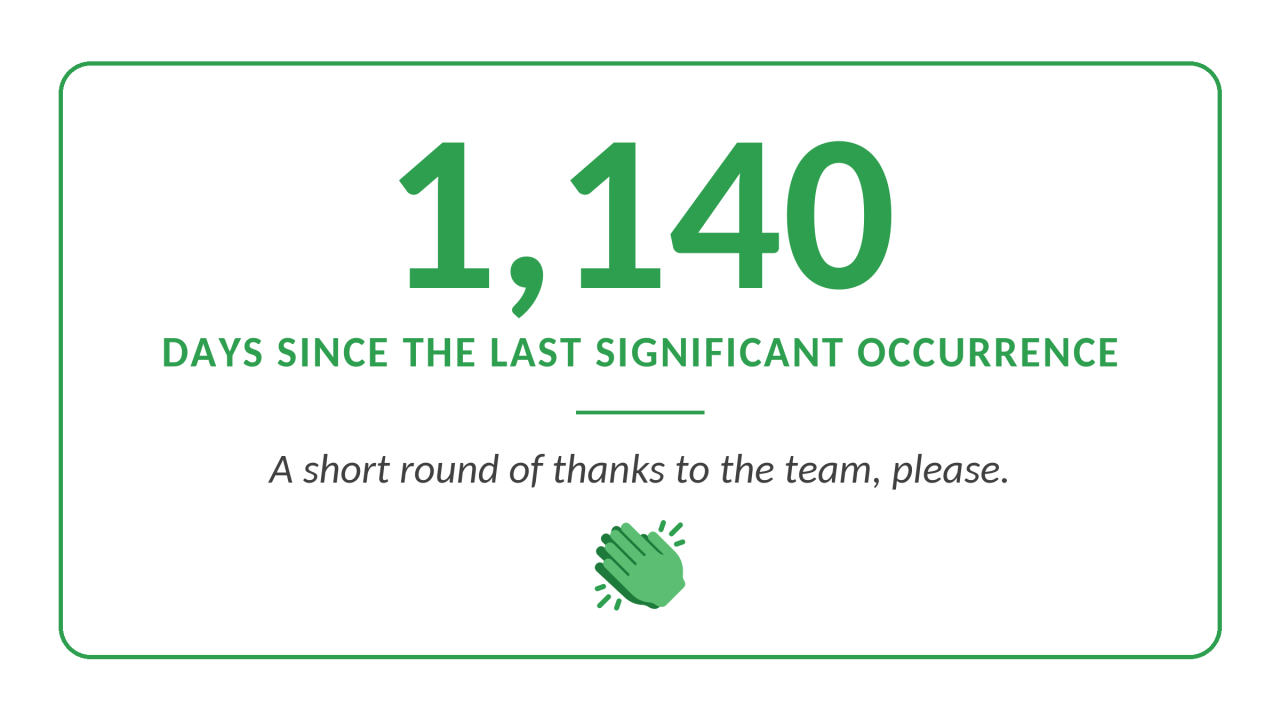
An item on the agenda is a proposal from Compliance Monitoring, proposing to change the internal audit frequency of the tool store from once a year to once every two years. The reason is clear and well written. The last five audits found nothing. Each audit takes two days of auditor time and the record shows it adds nothing of significant value.
Nobody disagrees. The item is approved in under two minutes.
Nobody asks the second question: why have the audits found nothing?
One possible answer is that their stores personnel keep tool control tight partly because they know the audit is coming. Moving the audit further away, the record may stay clean for a year or two. Then again, it may not it for up to two years or when there is a serious event. By which time it is too late!!
What a good record teaches us
A long run of good results does more than make us feel confident. It changes the scale we previously used to judge risk. Each safe month without reports, becomes evidence that the current way of working is safe enough. A hazard we have not seen for a long time starts to feel like a hazard that will no longer happen. Complacency starts to creep back in!!
Risk assessment scores stay the same because last year's scores were fine. Barriers that once seemed essential start to look like extra cost. Problem solved...right???
Part of this is outcome bias. We judge a decision by how it turned out, and we give less weight to how good the decision was at the time. If a shortcut worked and nothing went wrong, the shortcut looks like a good decision. The same shortcut, taken on the day a second failure is present, reads very differently in the investigation report.
In the Filthy Fifteen, this is Complacency, with Norms close behind. Complacency is often described as one person who stops paying attention, perhaps lulling themselves into a false sense of security. Even in a successful organisation, this can also happen to a whole management team at the same time, in a meeting, regardless of good intentions and data that is perceived as accurate.
How this connects to our last two articles
In previous article Complacency Isn't Laziness. It's Overload., we looked at a night shift where your Engineers and Technicians took shortcuts because the work did not fit the time-scale required to complete the task. In The Silent Warning Sign: "Nothing Ever Goes Wrong Here", we looked at what happens when reports stop coming in.
This article looks one level up. The shortcut on the hangar floor and the drop in reports both feed the same record. That record then goes into the board committee meeting as proof that the system works. Decisions are made on that proof, and some of those decisions remove the barriers that produced best working practice and a good record in the first place.
Why it is hard to see from the inside
- Drift in this regard is slow. Each change is small and has a good reason. No single decision looks like a risk. The risk is in the accumulated total.
- Evidence supports the decision. The numbers really are green. Anyone who raises a concern must argue against a clear record, often with a feeling rather than data.
- The people who remember why a barrier exists may have moved on. The procedure keeps the step, but nobody can explain it, so it looks like bureaucracy and a waste of productive time.
- Auditors see the same record. A clean audit history can confirm the belief rather than test a potentially dangerous assumption.
What it costs
The gap between the risk you think you have and the risk you actually have gets wider every year. Despite that many leaders think, no report shows it and no dashboard tracks it.
The first clear sign is often the event itself. When the investigation starts, it will find a series of reasonable decisions, all approved and all based on a record that is perceived as good. That is a hard finding for any Accountable Manager to read.
There is a cost to your people too. Your personnel often see the drift before management does. They notice when an audit moves further away or when a check disappears from the task. If they raise it and the answer is "our record says it's fine", they learn that the record matters more than what they see. Next time, they may say nothing. That brings us back to the silence we described in our last article.
A good record is worth protecting. The difficult part is knowing whether your record reflects a strong system or merely a lucky one and a clean set of numbers cannot tell you which.
🎓 Join our free 45-minute live workshop: Resetting Your Risk Radar: When a Good Record Hides Real Risk
Tuesday 1 December 2026, 09:30 London time. Places are limited to 25.
We will look at how a long run of success, changes the way teams judge risk and at the signs that your risk picture may have drifted. Register here.
💬 Prefer to talk about your own operation first? Book a Free 20-Minute One-to-One Discussion. It is optional, with no obligation.
Want to talk about this with other people in aviation, rail, road and sea transport? Join the free Safety Rebels Club. Share what you have learned in general terms. Do not name people or companies. Do not share confidential information.
📩 contact.us@aviaintelligence.com
Categories: : Nurture, Safety Culture, The Filthy Fifteen