7 Post-Holder Interfaces That Quietly Break Your SMS
 Rustom Sutaria
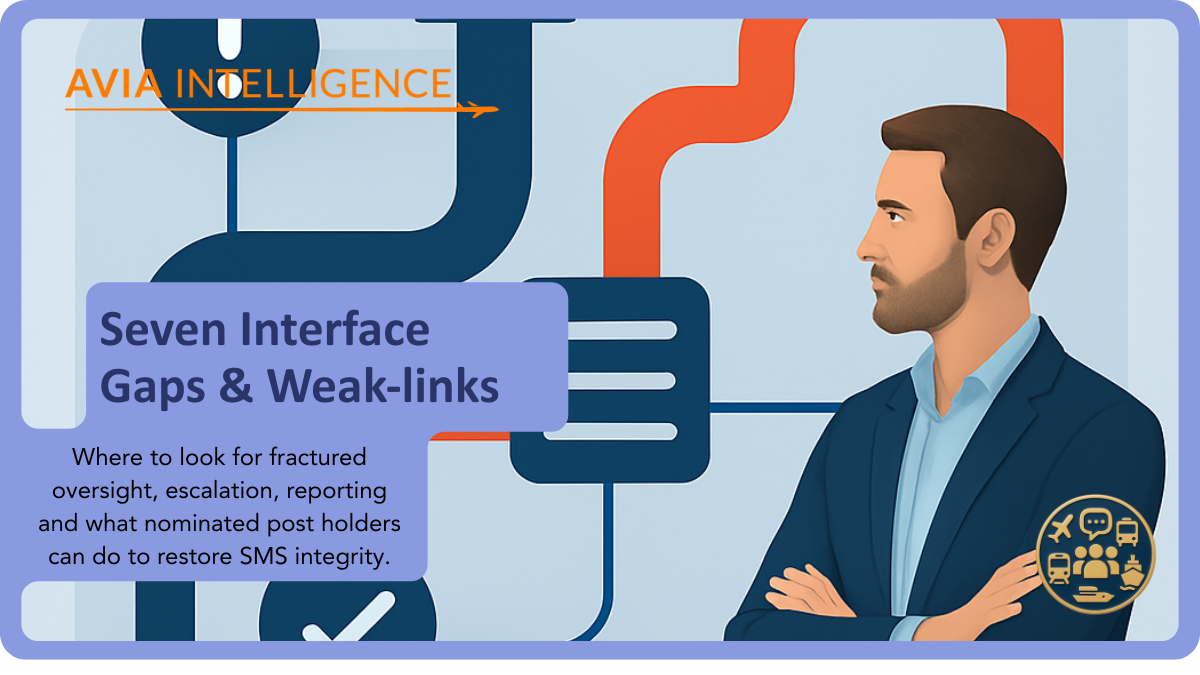
7 latent gaps and weak links that fracture oversight, escalation and reporting and what nominated post holders can do to restore SMS integration.
If you’re a nominated post holder, you don’t “own safety” alone. You own business interfaces: the joins between departments, accountabilities, contractors, and decision-makers where small distortions and deviations become big risk.
Many SMS's don’t fail because the manual is wrong; they fail because handover, escalation, oversight, and decision rights don’t behave the way the manual assumes.
Under normal conditions you can “get away with it.” Under pressure, those weak joins open and latent risk becomes visible. By which time it's too late.
This blog post focuses on seven interfaces that commonly degrade post holder responsibilities, weaken oversight, blur escalation, and fracture SMS integration.
Why interfaces break SMS
(even with good people)
Interfaces break the safety chain in three predictable ways:
- Ownership ambiguity: “Not my area or problem” becomes “nobody’s problem.”
- Information decay: reporting slows, becomes filtered, or loses meaning.
- Decision drift: locally rational decisions accumulate into unsafe outcomes.
As a Post holder, you sit where these failures concentrate: you sit at the boundary points.
The 7 interfaces that quietly break your SMS
1) Accountable Executive intent ↔ operational reality
Failure pattern: safety intent isn’t translated into decision rules; pressure quietly shifts “acceptable”; bad news is softened up the line.
Fix: define a few non-negotiable safety decision principles and require evidence of control effectiveness, not just compliance.
2) Safety ↔ Quality (assurance overlap without integration)
Failure pattern: parallel workflows create duplication, contradiction, and “two truths.”
Fix: align on risk exposure (“so what?”), use one action system, and share barrier/control effectiveness language.
3) Ops/Maintenance/Engineering ↔ safety reporting flow
Failure pattern: reports disappear into admin; feedback is slow; sensitive issues go verbal.
Fix: fast triage and feedback (acknowledge quickly, route promptly, act visibly, close the loop) supported by consistent Just Culture decisions.
4) Risk owners ↔ a single “risk picture” (multiple risk matrices, multiple safety realities)
Failure pattern: the same hazard gets different ratings; prioritisation breaks; escalation thresholds vary.
Fix: create an alignment layer: shared risk appetite, harmonised executive bands, and a translation table that preserves local detail while producing one coherent view.
5) Contractors/suppliers ↔ internal controls
Failure pattern: “approved” replaces oversight; handover hazards aren’t controlled; incidents become contract disputes.
Fix: define interface controls (handover standards, documentation/traceability, reporting expectations, escalation paths that bypass commercial friction).
6) Change owners ↔ operational teams (MoC done on paper)
Failure pattern: change is approved but the system isn’t ready; new hazards emerge at the edges; local workarounds that hide risk.
Fix: treat change as a controlled process with readiness checks and early monitoring for drift.
7) Investigation outputs ↔ decision-making
Failure pattern: strong investigations don’t change conditions; actions focus on reminders/training; learning doesn’t land where resources are set.
Fix: require investigation outputs that identify failed/inadequate/missing controls, specify system changes, and define how effectiveness will be proven.
A practical “post-holder” interface check
Ask in your next governance meeting:
- Where do we rely on verbal handovers?
- What triggers escalation and is it trusted?
- Can we prove controls work?
- Do leaders see one true risk picture?
- Do actions change conditions?
- What changed recently and what risk grew silently?
- Who owns each boundary?
What to do next
Stop treating interface issues as side-effects of the way your organisation is structured. Treat them as safety controls: name them, instrument them and audit the interfaces - not just the departments, or email contact.us@aviaintelligence.com to arrange a practical interface review and register with the Safety Rebels Club and get even more.